If you’re learning about embedded systems or planning an electronics project, you’ve probably heard the terms “microcontroller” and “microprocessor” before. At first glance, both may sound similar because they are “chips” utilised in electronics. However, in actuality, they are intended for quite distinct objectives.
In this blog, we will explain the difference between microcontrollers and microprocessors in a straightforward manner, using real-world examples and a clear comparison table. You will also learn about microcontrollers and microprocessors, as well as their applications in the real world.
You will also learn about microcontrollers and microprocessors, as well as their applications in the real world.
If you’re new to programming, don’t miss our guide on the Basics of Embedded C Programming for Beginners to understand how microcontrollers execute code.
Why do people confuse a microcontroller and a microprocessor?
Many students and beginners are confused by the difference between microcontrollers and microprocessors, which both appear in electronic systems.
However, the primary misconception arises because:
- Both are small chips
- Both can run programs
- Both are used in devices we use daily
But the truth is,
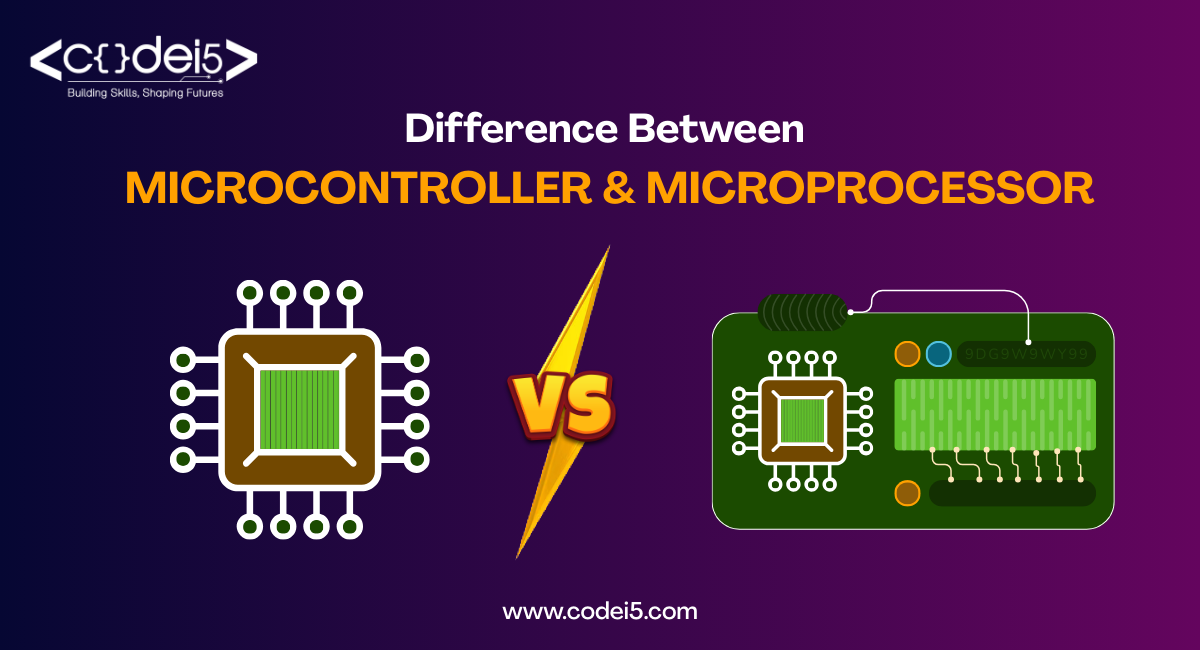
A microcontroller is used to control devices, whereas a microprocessor is for powerful computational operations. Once you understand the basics, the difference between microcontrollers and microprocessors becomes very clear.
2) What is a Microcontroller?
Let us begin with the most frequent one used in embedded projects.
What is a Microcontroller?
A microcontroller is a tiny computer contained on a single chip. It contains:
- CPU (processor)
- RAM (temporary memory)
- ROM/Flash (program storage)
- Input/Output pins (I/O)
- Timers, ADC, communication modules, etc.
So, when asked what a microcontroller is, the simplest answer is:
A microcontroller is a single chip that controls electronic devices and performs certain functions.
Example Microcontrollers:
Some popular examples are:
- Arduino (ATmega328)
- ESP32
- PIC microcontrollers
- STM32
Microcontrollers are typically used in compact devices when the chip needs to perform a single task efficiently.
3) What is a Microprocessor?
Now, let’s understand the other side.
What is a Microprocessor?
A microprocessor is essentially a CPU (central processing unit) on a chip. The chip does not have any RAM, ROM, or I/O modules.
So, a microprocessor requires external components such as:
- RAM
- Storage
- I/O controllers
- GPU (sometimes)
- Other chips for communication
When asked what a microprocessor is, you can describe it as follows:
A microprocessor is a powerful CPU that requires external memory and components to function. It is used for high-performance computing.
Example Microprocessors:
Common examples:
- Intel Core i3/i5/i7
- AMD Ryzen
- ARM processors in smartphones
- Raspberry Pi processor
Microprocessors are used in systems that require high performance and multitasking.
4) Difference Between Microcontroller and Microprocessor (Tabular Comparison)
This is the most important area for readers and the most effective for SEO. Here is a clear table demonstrating the difference between microcontroller and microprocessor.
| Feature | Microcontroller | Microprocessor |
| Definition | All-in-one chip (CPU + memory + I/O) | Mainly CPU only |
| Memory | Built-in RAM & Flash | External RAM & storage required |
| Cost | Low cost | Higher cost |
| Power Consumption | Very low | High |
| Speed | Medium | Very high |
| Best for | Embedded control tasks | Complex computing tasks |
| Applications | IoT devices, appliances | Computers, smartphones |
| Example | Arduino, ESP32, STM32 | Intel, AMD, ARM processors |
This is one of the best ways to understand microcontroller vs microprocessor quickly.
5) Architecture Difference (CPU, Memory, I/O, Peripherals)
Let us simplify the architectural difference.
Microcontroller Architecture:
A microcontroller has everything inside it:
- CPU to process instructions
- Flash memory to store a program
- RAM for temporary data
- I/O pins to connect sensors and motors
- Built-in peripherals like UART, SPI, and I2C
That is why microcontrollers are excellent for devices that perform specific tasks, such as turning on a motor, reading a sensor, or operating a display.
Microprocessor Architecture:
A microprocessor is mainly a CPU; hence, it requires:
- External RAM
- External storage (SSD, eMMC, etc.)
- External I/O controller
- Extra chips for communication
Microprocessors are designed for high-performance systems such as laptops and smartphones.
6) Applications of Microcontroller vs. Microprocessor:
Now, let’s look at how these are used in real life.
Applications of Microcontrollers:
Here are some common applications for microcontrollers in daily devices:
- Washing machines
- Microwave ovens
- Smart fans and smart lights
- Remote controls
- Smartwatches
- IoT sensors
- Robotics projects
- Digital thermometers
- Home automation systems
Microcontrollers are ideal for devices that perform a certain function on a regular basis while using minimal power.
Applications of Microprocessors:
Here are some common applications of microprocessors:
- Desktop computers
- Laptops
- Smartphones
- Tablets
- Gaming consoles
- Raspberry Pi-based systems
- AI and machine learning systems
- High-end industrial computers
Microprocessors are used for high performance, multitasking, and advanced processing.
7) Which One Should You Choose?
This is a popular question among beginners. Let’s make things easy.
Choose a Microcontroller if:
- You are creating an IoT project.
- You need low-power consumption.
- Your device performs one essential duty.
- You desire low costs.
- You’re manipulating sensors, motors, and relays.
Examples:
- Smart irrigating system.
- Home Automation Project
- Robotics
- Temperature Monitoring
Choose a Microprocessor if:
- You need great computer power.
- You wish to run Linux/Windows.
- You need to multitask.
- You’re creating an advanced computer system.
Examples:
- Smart kiosk
- AI-based camera
- Raspberry Pi projects
- Industrial computing systems
So, when deciding between a microcontroller and a microprocessor, it all comes down to the type of project you’re working on.
8) Why This Topic Matters for Embedded Systems Learners?
If you want to work with embedded systems, this is a must-know. Most interviews and practical tasks begin with this same notion.
At Codei5 Academy, we teach these ideas using real-world examples so that students can properly comprehend and apply the fundamentals in projects.
Learn Embedded Systems with Codei5 Academy:
If you are serious about pursuing a career in embedded systems, mastering the fundamentals is insufficient.
- Embedded Systems Course in Coimbatore
- Advanced Embedded Systems Course in Coimbatore
At Codei5 Academy, we focus on:
- Hands-on hardware learning
- Microcontroller programming
- Embedded C fundamentals
- Sensor integration
- Real-time project building
If you’re looking for a good spot to start your embedded journey, Codei5 is an excellent choice for learning and growth.
If you’re planning to build a career in this field, read our blog “What are the career roles in Embedded Systems?” to explore job opportunities and role types.
Frequently Asked Questions:
1) Which is better for beginners: a microcontroller or a microprocessor?
For beginners, a microcontroller is usually easier because it is simple, inexpensive, and ideal for basic embedded projects.
2) Can I learn both microcontroller and microprocessor in a single course?
Yes, an effective training program teaches both fundamental and advanced concepts step by step through real projects.
3) Do embedded system jobs demand understanding of microcontrollers?
Yes, most embedded professions demand an extensive understanding of microcontrollers, interfaces, and real-time applications.
4) What types of projects can I create with microcontrollers?
You may create IoT devices, robotics, automation systems, sensor-based projects, and smart home apps.
5) Where can I learn embedded systems professionally in Coimbatore?
You can join the Advanced Embedded Systems Course in Coimbatore and the Embedded Systems Course in Coimbatore at Codei5 Academy for hands-on training and real-time projects.
Conclusion:
Understanding microcontrollers vs. microprocessors is simple when you remember this: Microcontrollers are ideal for controlling low-power, low-cost devices, whereas microprocessors are optimised for high-performance computation and multitasking. If you want to work in embedded systems, studying both ideas through real-world projects can help you develop solid fundamentals and effectively navigate interviews.